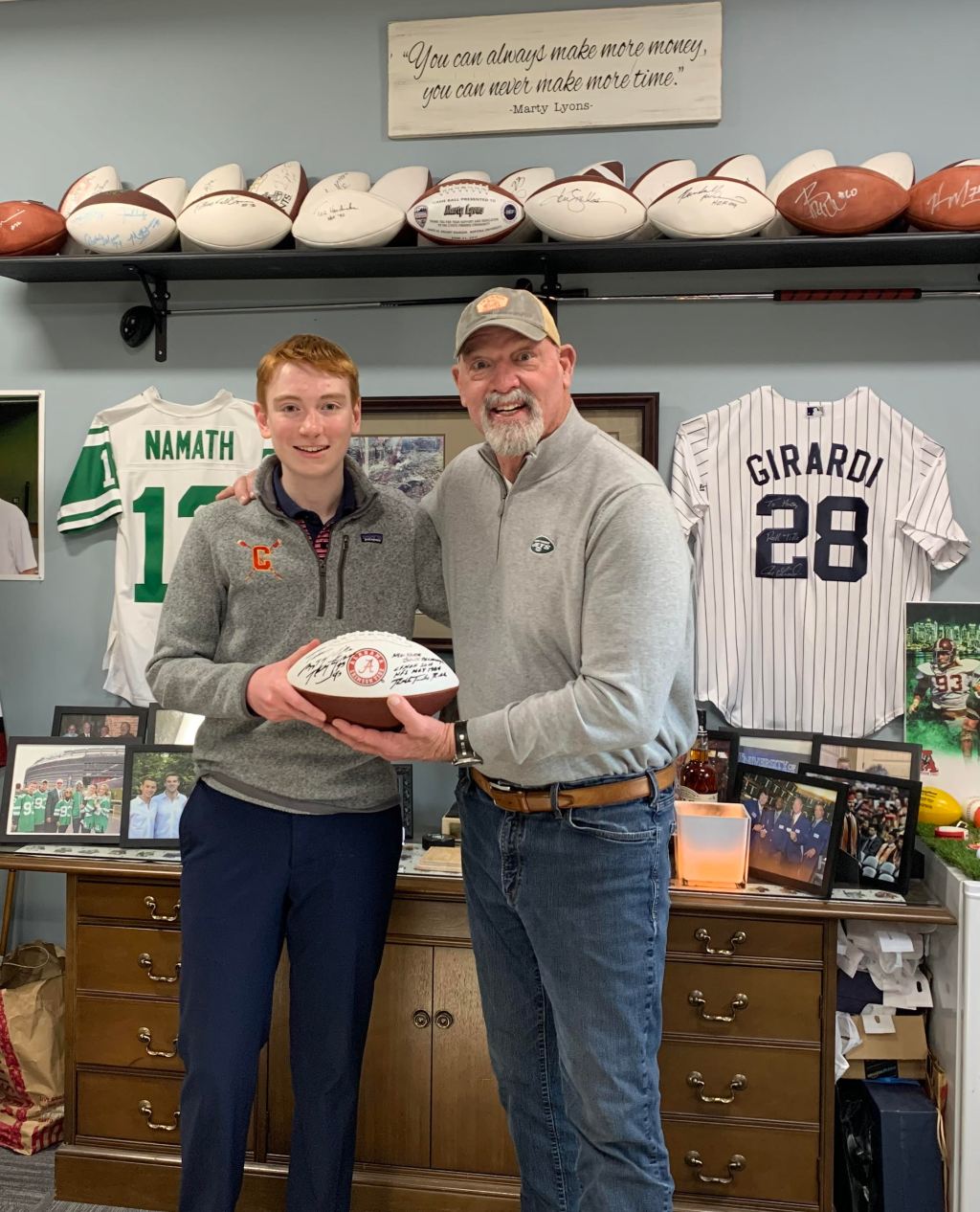
by Timothy Stoeber ’26

Marty Lyons, Joe Klecko, Mark Gastineau, and the late Abdul Salaam comprised the famous defensive line of the early 1980s New York Jets that was known as “The New York Sack Exchange.” The nickname was the result of a fan contest won by Dan O’Connor, who referenced the foursome having rung the opening bell at the New York Stock Exchange in November 1981.
The Sack Exchange was known for terrorizing opposing quarterbacks by overpowering and outmaneuvering the other teams’ offensive lines. It was their ability (along with linebacker Lawrence Taylor’s) to sack the quarterback on such a regular basis that the NFL started keeping track of sacks as a statistic.
Although the foursome played terrifically as a unit, they were anything but friends. As highlighted in ESPN’s 30 for 30 episode “The New York Sack Exchange” (2024), they butted heads with one another almost as much as they did with the other teams’ offensive lines. Lyons noted that the foursome achieved a lot, but that they indeed had four very different personalities.
“Sometimes, like peanut butter and jelly, it’s a perfect match – and sometimes it’s not,” he stated. But Lyons feels “blessed to have been surrounded by good people” his entire life, starting with his family.
Lyons credits his parents for instilling the virtues of the Catholic faith in him and his six siblings at an early age. All seven attended Catholic grade school and high school. The parents, both of whom were active in the church, made sure that the entire family went to Mass every Sunday. Reflecting on his own high school days in Florida, Lyons noted that “Chaminade High School is special in that it gives students the opportunity to build a strong foundation” for their time in college and beyond. He hopes its students appreciate the sacrifices that their parents make in order for them to attend Chaminade.
Lyons played college football at the University of Alabama and was coached by the legendary Bear Bryant. Coach Bryant stressed life’s core values in his teaching, not just football. He wanted his players to be proud of their families and their religion and get a good education. “And if we have time, let’s try to win some football games,” Lyons recalled Bryant saying. They did win a lot of games, including the National Championship in 1978.
Lyons won the NFL’s Walter Payton Man of the Year Award in 1984 for his work with the Marty Lyons Foundation, which provides wishes for terminally ill children. The impetus for creating the foundation was a series of three events that occurred in less than a week’s time: the birth of his son, Rocky, the sudden and unexpected death of his father, and the death of a child to whom he had been a “Big Brother” through the Big Brothers Big Sisters of America program. Lyons wondered why God allowed this to happen. Relying on his strong faith, he came to the conclusion that “we live by God’s plan” and that God wanted him to “know that there is a bigger picture in life.” That picture was for him to help kids. Since its establishment in 1982, the Marty Lyons Foundation has raised over $44 million dollars, helped over 8,600 families, and now has chapters in 14 states.
In addition to his terrific play, Lyons is known as having a role in one of the NFL’s most famous video clips. It all started with him sacking Hall of Fame quarterback Jim Kelly. Lyons was on top of Kelly and “words were exchanged.” (Lyons advice: “Never start a fight when someone is on top of you.”) The Jets were penalized 15 yards because after Lyons tackled Kelly, he then roughed him up. But it is the ref’s announcement to the crowd that makes the clip a classic. According to the ref, Lyons “was giving him the business down there,” a penalty that is definitely not among the approximately 50 infractions recognized in the official NFL rulebook. Both players were fined $800 and the money was given to charity. Lyons and Kelly laugh about the whole thing now.
After his playing days were over, Lyons spent 22 years as a radio color commentator for the New York Jets.
During Tarmac’s meeting with Lyons, he provided great advice for young people, stating, “Life is a team sport but you gotta always believe in yourself—even if others don’t. Don’t let anyone cheat you out of life.”
He also emphasized that “to make a difference, all you have to do is care. You don’t have to be a professional athlete. You have to take time to listen. Listening is the biggest way to learn.”
If you would like to learn more about the Marty Lyons Foundation please visit The Marty Lyons Foundation.
 chstarmac.com