By Ryan Nicol ’25
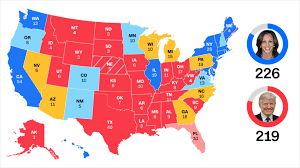
Days before the election, with the campaign dust mostly settled and everything coming into focus, the senior division of the social studies club made a prediction about the result of the presidential election—Donald Trump wins in five of the seven swing states, while Kamala Harris takes two, meaning Trump wins the presidency with 296 electoral votes to Harris’ 242. This serves as a follow-up to that prediction, with comparison to the final election results. As usual, Tarmac does not endorse any candidate for any election, including President-elect Trump or Vice President Harris.
To provide a brief recap, the rationale behind the states Trump won was simple. Aside from North Carolina, which had voted Republican multiple times in a row but could only theoretically vote for a Democrat, the four other states Trump was projected to win had that label because of their concern for winning conservative issues. National security, foreign policy, immigration, and above all else, the economy, were all issues that the right won among voters this election cycle. As mentioned previously, two states were anticipated to lean toward Harris; Nevada, because it was the left-wing counterpart to North Carolina, and Wisconsin, because the Democrats had a winning issue there with abortion rights. Just as the most prestigious political oracles had stated, our social studies club agreed—Pennsylvania’s winner would likely be declared the winner of this close election.
Reality was not far off, but the former President did what no one expected: he won every swing state. Still looking through the lens of top political issues, the five states Trump was projected to win were correct, while Harris’ two were just elusive. In Nevada, it was assumed it would continue its streak of voting blue, but immigration issues were underestimated in a state located by, but not at, the border with Mexico. Wisconsin, on the other hand, was thought to care about abortion, which would decide the election there in favor of the Democratic Party. Yet, as is for most elections, the economy was the number one issue, in a state whose blue-collar workers wondered if they could buy groceries in the present rather than achieving controversial rights for the future.
It is never as simple as a few topics of debate; Harris is widely considered to have won her debate against Trump, after all. One of the changes the Republican Party made since 2020 was an embrace of early voting and mail-in ballots. Four years ago, Trump and other conservative politicians were skeptical of the election result because of its more progressive voting systems rather than the traditional voting method of showing up after work on Election Day. Since then, to make the election “too big to rig,” there has been a call from the GOP to vote early because, logically, many voters would not be able to get to the polls in time on November 5. The left still had a lead among early voters, but it was a dramatically smaller one in comparison to the 2020 election.
Young voters were also a tipping point for the Republicans. The youngest voting bloc typically trends to the left of the general population, but Trump made gains among this group, which looked at the economy and housing prices and saw that the conservative rhetoric may be more supportive of their future. Young males, in particular, were a group harnessed by the GOP, due to endorsements and collaborations with extremely popular figures of massive online influence, such as Joe Rogan, Jake Paul, Dr. Phil, Tony Hinchcliffe, Tucker Carlson, Kanye West, Dana White, Hulk Hogan, and Elon Musk—the last of which was appointed by Trump to run a government entity in his administration alongside Vivek Ramaswamy.
As the economy was certainly a winning issue for conservatives, Chaminade students predicted that Trump would win the election over Harris. That much was true. But no one had it in their mind that all of the swing states were achievable for one party, on top of complete control of Congress (and the Supreme Court). Still, as proven by the former President and his very well-run campaign leading up to November, it was possible and it did happen, as a result of typical political issues, celebration of early voting, and endorsements from those with the most public influence among young people, showing that the Republicans did not have to be viewed as a party of evil like in 2020. That effect, rather than in five of seven swing states, was felt everywhere. The “red wave” of 2022 was never stopped; it was just delayed.
 chstarmac.com